
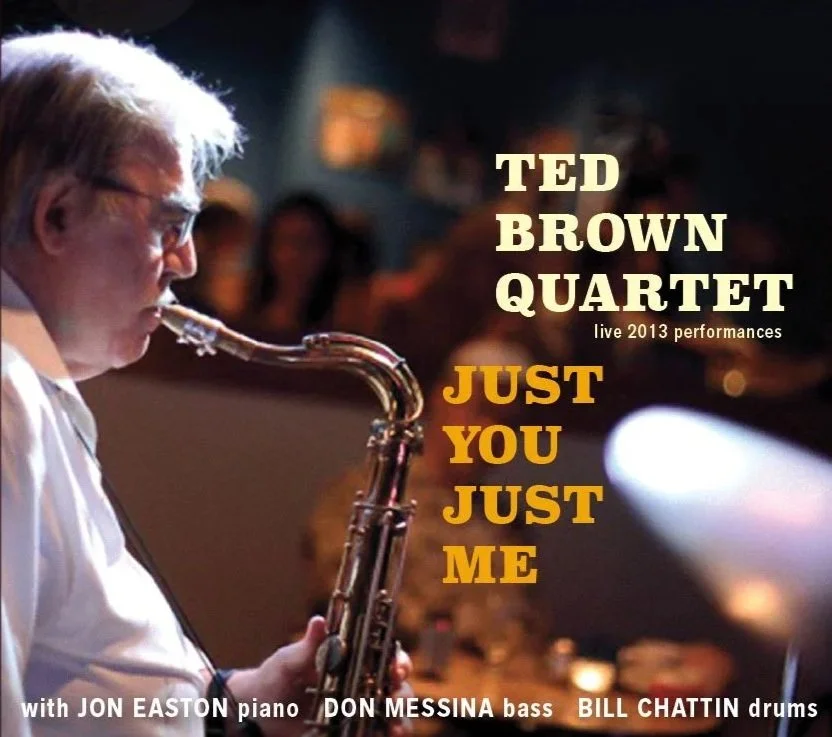
Just You Just Me
NA1079
TED BROWN QUARTET
Ted Brown, Tenor Saxophone
Jon Easton, Piano
Don Messina, Bass
Bill Chattin, Drums
1.After You've Gone
2. Gone with the Wind
3. I Can't Believe That You're in Love with Me
4. Just You, Just Me
5. It's You or No One
6.Everything Happens to Me
7. I'm Getting Sentimental Over You
REVIEWS
Tenor saxophonist Ted Brown must be the oldest surviving student of Lennie Tristano. He was born in Rochester, New York, in 1927, which makes him a contemporary of Lee Konitz. An uncle taught him clarinet and tenor saxophone. After performing in army bands and working in Hollywood (1945–8), he moved to New York to study with Tristano. During 1955-57 he worked with Tristano, Konitz and Marsh, and recorded as a leader. Subsequently he recorded periodically with Konitz, and led a quintet with him in the 70s.
Here we hear Ted Brown with a trio of fellow Tristano school musicians, all of whom perform at a superlative level in this rather particular modern jazz idiom. Jon Easton is a pianist I've not heard so much from, compared with other Tristano players. His long solo on I'm Getting Sentimental Over You in particular is a revelation – sinuous, complex, with unusual note-choices. Don Messina and Bill Chattin make for an excellent rhythm team.
Brown himself is in remarkable form for someone of eighty-six at the time of these recordings. They were made at a number of venues in the New York and New Jersey areas during 2013. As expected, the programme consists of familiar standards, in this case without contrafacts. Everything Happens to Me is a plangent ballad. But a highlight is a wonderful interpretation of It's You Or No One, in which Brown's powers of invention are superlative; Easton's contribution is also highly memorable here. The tenorist's sound is close to that of Warne Marsh, but fully individual and distinctive. As Jimmy Halperin comments in his contribution to the sleeve-note, it's a beautifully smooth line. This is sophisticated, powerful and compelling music – and a highly recommended release.
Tenor saxophonist Ted Brown was one of many artists who benefited from his studies with pianist Lennie Tristano. During the late ’50s, Brown worked and recorded with fellow Tristano saxophone-playing alumni Lee Konitz and Warne Marsh, though he pursued a full-time career as a CPA outside of jazz, continuing to perform but not returning to record again until 1976, when he reunited with the former for the Konitz Quintet’s Figure & Spirit (Progressive).
The music on Just You Just Me consists of live recordings in 2013, while Brown was in his mid-80s, taken from several clubs in New York and New Jersey and featuring his quartet (active between 2000-15): Jon Easton (piano) and Bill Chattin (drums), both of whom also studied with Tristano, plus Don Messina (bass). Brown’s approach has not changed much over the years, having retained Tristano’s influence and knowing a song inside out, including the lyrics.
He plays with a soft, Lester Young-like tone, while acknowledging the influences of Konitz and Marsh as he continued to grow as an improviser. The songs are all decades-old standards, starting with the warhorse “After You’ve Gone”, played at brisk tempo by the driving rhythm section, the leader sharing the solo spotlight with Easton. The setting of “Gone With the Wind” is a foot-tapping swinger, again showcasing the pianist, this time taking a more abstract approach. The breezy rendition of “It’s You Or No One” finds the saxophonist at a creative peak, making great use of solo space and also featuring each member of his band to excellent effect. The leader embraces the melancholy air of “Everything Happens to Me”, conveying the lyric’s message with his dry toned, poignant tenor playing, accentuated by Chattin’s brushwork and featuring Messina’s understated bass lines backed by soft scatting. The Tristano spirit is on full display in the snappy finale of “I’m Getting Sentimental Over You”, taking the tune out of its usual slow ballad setting, the quartet achieving another highlight from these welcomed, previously unreleased performances.
It is unfortunate that Ted Brown, who turned 98 last month, isn’t more widely known, but these late in life recordings reveal a master who was still atop his game well into his 80s.
Bassist Don Messina was lucky enough to play with tenor sax legend Ted Brown in the mid 1990s. He was even luckier when he began to play regularly with Brown in groups that included drummer Bill Chattin, saxophonist Jimmy Halperin or pianist Jon Easton. Luck struck again in 2013 when that group recorded their one and only release (Live at Trumpets) for the Cadence label. With the release of Just You, Just Me, fans of the Lennies Tristano-inspired music of Brown are the lucky ones. Messina and New Artists unearthed seven tracks recorded during 2013 at various venues in New York and New Jersey that capture the clarity and precision of Brown’s melodic inventions. Steeped in the lessons he learned from Tristano, Brown and the trio of Messina, Chattin and Easton delight in exploring up tempo swingers such as “After You’ve Gone” and “I Can’t Believe That You’re in Love with Me” as well as evocative ballads such as “Everything Happens to Me” and “I’m Getting Sentimental Over You.” Brown’s light and airy tone and his flowing lines are perfectly suited for this set of standards that also includes the title track, “Gone with the Wind” and “It’s You or No One.” The trio of Easton, Messina and Chattin are perfect bandmates for Brown’s understated, yet expressive approach. Having studied with both Tristano and pianist Sal Mosca, Easton’s solos are full of finesse and percussive accents. Chattin, who also studied with Tristano, drives the group with his soft touch and his keen understanding of the tunes. Messina’s solid timekeeping and sensitive and storytelling solos are inspired by his association with Tristano that began in 1973. Since his first recording in 1956 (Freewheeling), Brown’s output has been sparse with only a dozen or more releases to his name, not to mention his sessions with Konitz, Marsh and Tristano. Having recently celebrated his 98th birthday, Just You, Just Me is a reminder of the beauty, creativity and passion Ted Brown brought to the music. Like Messina, we are lucky to be recipients of his gifts.
BOTTOM LINE: Saxophonist Ted Brown turned 98 in early December. What better way to celebrate this milestone than with Just You, Just Me, a collection of tunes recorded in 2013. Rooted in the teachings of Lennie Tristano, Brown and the trio of Jon Easton on piano, Don Messina on bass and Bill Chattin on drums deliver a session of laid back swing and understated inventiveness.
I don’t know how 98-year-old tenor saxophonist Ted Brown’s album Just You Just Me ended up on New Artists Records, given his eight decades of musical expression, but his long-standing presence on the jazz scene is nevertheless new to me. Thanks to friend and fellow baseball fan Don Messina, the superlative bassist on this release, for clueing me in to Brown. The first thing that captured me on the album is Brown’s sound, which draws my ear as irresistibly as a magnet attracts iron filings. How does he get that “hollow gourd sound,” as described by the quartet’s pianist Jon Easton in the liner notes, from a metal instrument? The second thing that caught me was Brown’s unhurried and relaxed playing, even when generating 32nd and 64th notes on uptempo numbers. He allows the music to breathe, forces nothing, and eschews pyrotechnical flash, unspooling improvised story lines that are as surprising as they are logical. Somehow this reduces the length of the tracks, so that 7+- and 8+-minute performances seem to pass much more quickly. The third thing that grabbed me is the relentless swing of the rhythm section, which also includes Bill Chattin on drums, and the way Easton’s more angular approach pairs nicely with Brown’s flow. (All these fellows, by the way, have a direct connection to Lennie Tristano.) Drawn from excellent live recordings made in 2013 at various locations in New York and New Jersey, when Brown was in his mid-80s, the album features seven standards addressed in a genuinely spontaneous, robust, and thoroughly entertaining way.
Tenor-saxophonist Ted Brown, who will be turning 98 this month, was 86 at the time of the previously unreleased performances on Just You, Just Me. The cool-toned tenor, inspired by Charlie Parker, Lester Young, Lee Konitz, Warne Marsh and his teacher Lennie Tristano, always had a thoughtful and melodic approach. Like Marsh, he was always able to come up with a seemingly endless amount of creative ideas while playing over the chord changes of standards.
The trio of pianist Jon Easton, bassist Don Messina (who made this release possible), and drummer Bill Chattin have played together for decades and they worked regularly with Ted Brown during the time of this album. The recording quality is decent with the music being documented at several clubs in 2013. Brown stretches out on such numbers as “After You’ve Gone,” “I Can’t Believe That You’re In Love With Me,” and “It’s You Or No One,” displaying an attractive tone and a style that is both searching and logical. Easton and Messina also get their share of solo space, playing with their own creative ideas while allowing the spotlight to mostly be on the legendary if still relatively little-known tenor.
–Scott Yanow, Los Angeles Jazz Scene, December 2025
Ted Brown's 2013 album, recorded at various locations in New York and New Jersey, is steeped in the traditions of both Lester Young and Lennie Tristano, but what emerges is distinctly his own. Born in 1927, Brown channels the inspirations of these jazz giants, yet asserts his own individuality in every phrase. The ghostly presences of Young and Tristano haunt the grooves, but Brown's interpretive voice remains unmistakable.
Tristano's concept of improvisation—marked by avoidance of standard licks and clichés—prioritizes spontaneous creation over formulaic repetition. His solo work is distinguished by extended, linear phrases, rhythmic freedom, and intricate block chords. By rejecting the irregular accents of the bebop tradition in favor of a more flowing rhythm, Tristano laid the groundwork for cool jazz, yet his influence transcends any single stylistic label.
Brown is celebrated as a tenor saxophonist firmly rooted in the Tristano school. His playing is defined by melodic inventiveness, relaxed swing, and a devotion to improvising over familiar standards, always delivered with self-assured artistry. Brown's sound is often described as pallid and clear, favoring linear improvisation and demonstrating a deep affinity as for Tristano's method of "note-to-note in the moment spontaneity," as liner notes state. This organic, intuitive melodic flow, paired with an "airy" yet soulful tone, lends warmth and restraint even amid harmonic complexities.
Brown's preference for working with well-known jazz standards, or original lines crafted over familiar progressions, helps foster musical connection and spontaneity. His improvisations, true to Tristano's ethos, feature purity and freshness; rather than trotting out stock patterns, Brown builds long, linear phrases characterized by rhythmic freedom.
Brown's artistry pivots on melodic invention, contrapuntal interplay and an introspective lyricism. He occupies a distinct niche in postwar jazz, upholding the sophistication and clarity of the Tristano school while channelling the warmth of the Young tradition.
Key albums showcasing Brown's artistry include Complete Free Wheeling Sessions (Lonehill Jazz, 2014—with Art Pepper, Warne Marsh), Jazz of Two Cities(Imperial, 1956) and Dig It(SteepleChase, 1999—with Lee Konitz). These recordings highlight his blending of classic swing influences with the advanced linear innovations of the Tristano School, making him an important though often underrated figure in modern jazz.
On "Everything Happens To Me," lingers over the tune's melancholia, allowing familiar emotions to resonate with listeners. His variations unfold organically, exhibiting a tone reminiscent at times of Marsh, but ultimately closer to late Young. Jon Easton's lyrical piano solo matches the mood perfectly, followed by Don Messina's sensitive bass embroidery. In Brown's concluding chorus, new variations soar, leading the piece gracefully to its end.
"Just You Just Me" is driven by Messina's jaunty rhythm. Brown breaks away with inspiration, emphasizing melodic development over mere virtuosity. The piano's low-register explorations complement Brown's melodic certainty, echoing Tristano's percussive sensibility. Their ensuing duet has a gentle confidence and a tangible musical rapport.
Easton describes Brown's tone as a "pure hollow gourd sound." The second chorus of "Gone With The Wind" bursts with invention, while Bill Chattin's drumming remains creative yet unobtrusive. Easton's clarity and commitment to a consistent musical line mirror Brown's own approach, and their piano-tenor duet at the piece's close is both delightful and skillful.
Messina's liner notes are perceptive: he calls Brown's playing "kind-hearted," and observes how the music gently wins listeners over without force. Easton further notes that Brown's melodies are conceived on-the-spot—real, honest improvisations in the jazz tradition—reminding us how often jazz is diluted by gimmicks or preconception, rather than born from genuine moment-to-moment creativity.
Brown, born in the 1920s, still playing in the 2010s, is a witness to the cool vitality of his cool school mentors.
–Jack Kenny, All About Jazz, November, 2025
Cool jazz started at the tail end of the 1940s and was a reaction of sorts to bebop’s saturation of the market. While bop was bluesy, furiously fast and wonderfully fractured and polyrhythmic, cool was drier, avoided the blues and vibrato, included elements of classical and was played largely by musicians who had been to music school on the G.I. Bill after World War II or had studied formally. [Photo above of Ted Brown]
Cool had its own rules and stylistic quirks, pioneered mostly by pianist Lennie Tristano. Saxophonists also tended to play on the high end of their instrument’s register.
At the vanguard of the cool movement were musicians such as Tristano, Miles Davis, Lee Konitz, John Lewis, Sal Mosca, Gerry Mulligan, Dave Brubeck, Warne Marsh, Denzil Best, Paul Desmond, Billy Bauer and, by 1956, tenor saxophonist Ted Brown.
On December 1, Ted will turn 98. He is the last of the early cool jazz players. Perhaps his best-known recordings were his initial releases: Jazz of Two Cities (1956), paired with Marsh; Free Wheeling (1956), which featured Marsh and Art Pepper; and Lee Konitz Meets Jimmy Giuffre (1959). But his later albums are glorious as well.
Now, a new album by Ted of previously unheard live dates has just been released. Recorded at various clubs in New York and New Jersey in 2013, Just You Just Me (New Artists Records) features a stellar trio behind Brown—Jon Easton (p), Don Messina (b) and Bill Chattin (d).
The album’s fidelity is fantastic, and Ted’s horn is spirited and dry as a bone. The trio behind him is embracing—with Jon’s cool keyboard attack, Don’s big bass sound and the delicate touch of Bill on brushes.
I love cool and its metronome-like precision and yearning expression. Here Ted shows off his wealth of ideas and lifetime of experience on marvelous improvised solos, showcasing his airy, laid-back tone and swing.
Ted is a treasure, and we owe Don Messina a debt of gratitude for working hard to get this material released. It’s a time capsule that features a sound that is all but gone today. As revolutionary as cool was, it could be fussy and didn’t have much commercial appeal at the time. By the mid-1950s, cool was overtaken by hard bop.
Before I share Ted’s new album, here’s a cool jazz classic—the Lennie Tristano Sextet playing Wow, in March 1949, featuring Lee Konitz (as), Warne Marsh (ts), Lennie Tristano (p), Billy Bauer (g), Arnold Fishkin (b) and Harold Granowsky (d).
Here’s Crazy She Calls Me from Ted’s Free Wheeling (1956), with Art Pepper (as), Ted and Warne Marsh (ts), Ronnie Ball (p), Ben Tucker (b) and Jeff Morton (d).
—Marc Myers, Jazzwax, November 2025
Apart from a 1956 album by Ted Brown with Art Pepper and Warne Marsh, Freewheeling, and a 1959 album with Lee Konitz, Marsh and Jimmy Giuffre, Ted Brown seemed to vanish into the Californian mist - one of those will o' the wisp figures who are here one day and gone the next.
Or so I thought!
In actually fact, although pushing 98, Brown is still with us recording this live album in and around New York and New Jersey as relatively recently as 2013. What's more he still has that unique, icy cool sound that fitted in so well with Konitz and Marsh.
After You've Gone Has four minutes of non stop tenor before piano gives him a break. Gone With the Wind is a nice easy swinger with pianist Easton stretching out, before Messina has his say. The track closes with a gentle exchange of fours between tenor and piano.
I Can't Believe That You're in Love with me achieved a degree of popularity after Jo Ann Greer ghosted actress May Wynn's voice in the film The Caine Mutiny. No mutiny in this quartet, they swing as one with Chattin's brushwork particularly effective. Just You, Just me finds Brown in Lestorian mode with a suggestion of the tune's contrafact, Spotlite, hinted at. Messina, metromic in support loosens up with a great solo.
It's You or No One is a good tune and the quartet do it no harm at all maybe even enhancing it. Fine solos by all four. Some of the entwining lines between sax and piano bring to mind Brubeck and Desmond before they got involved in that odd time signature mullarky.
Everything Happens to me is given the balladic treatment it deserves. I sense that Brown, even when he's improvising is thinking as much about the words as the chords - him and Lester working the same side of the street. Rich harmonies from Easton and Messina who, incidentally provides informative background notes in the booklet.
I'm Getting Sentimental Over You. An out and out swinger to close with each one giving it their best shot as they have done throughout the album. Brown's solo is practically a re-writing of the head.
Years ago I attended concerts by Pepper, Marsh and Konitz but never caught Brown. With this live album I've theoretically got the set. Despite the Fi being less than Hi, as is so often the case with in situ recordings, if anything, it enhances the feel of actually being there. Recommended.
—Lance Liddle, Bebop Spoken Here, November 2025